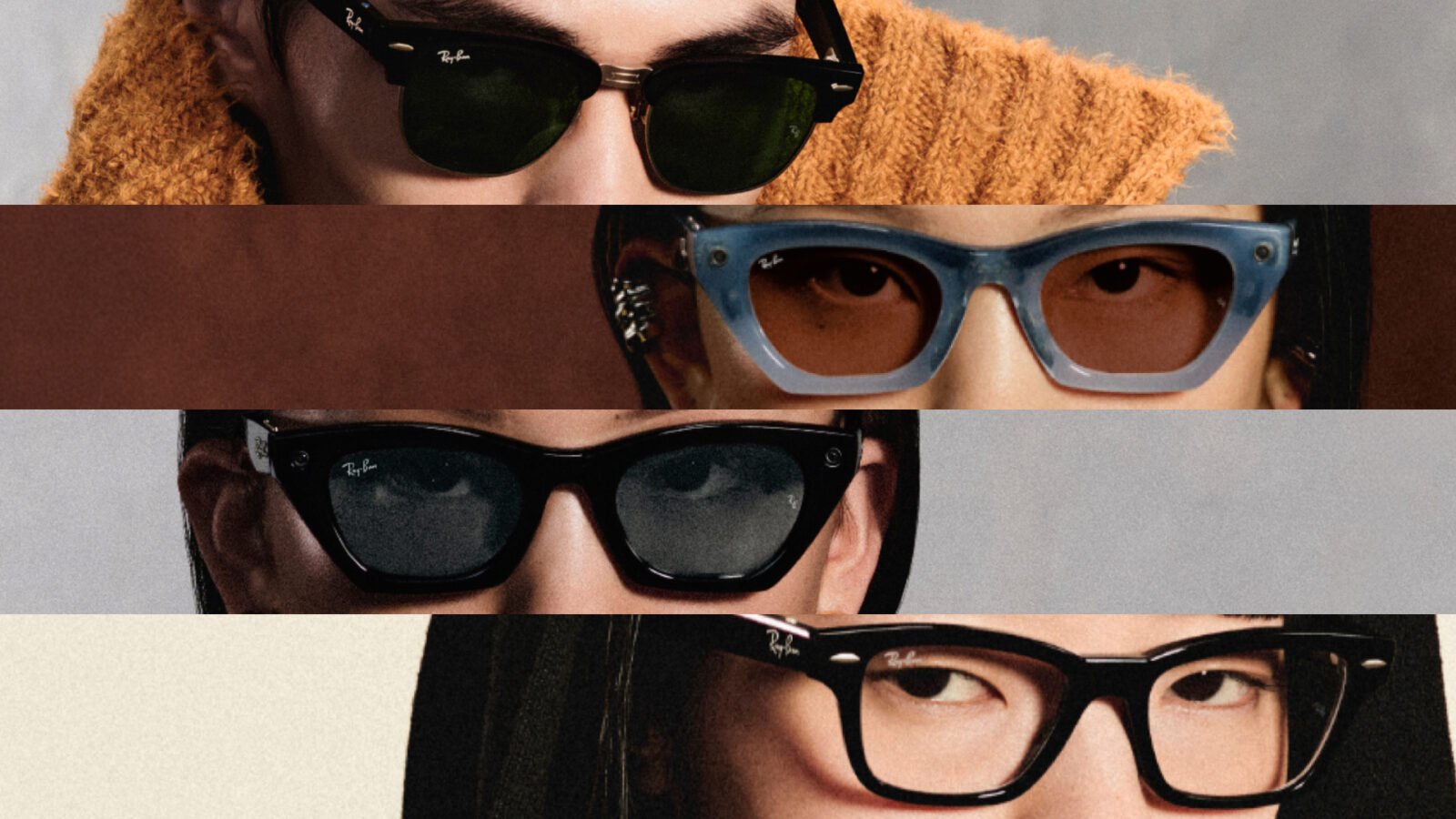

Earlier this week we argued that the chat era is over and the agent era has started. This week, at Meta Connect, that argument got a face. Literally.
Meta’s annual keynote is where the company turns its roadmap into products you can preorder, and this year’s show was unusually worth your attention. It answered the question our last piece left hanging: if AI is no longer a chatbot but an agent that acts in the world, where does it live? Meta’s answer: on your face.
The lineup, in plain English
Four announcements matter, and only two of them matter right now.
The Ray-Ban Meta Gen 3 (from $449, available now) is the new flagship: slimmer frames, a six-microphone array, 3K video recording, and a small tactile button that summons the AI without reaching for your phone. New shapes join the range, including an Aviator and a cat-eyed Zena.
The Ray-Ban Meta Audio (from $349, ships October 13) is the interesting one. It is Meta’s first pair with no camera at all. No recording, no indicator light to explain, no wondering whether you are being filmed across the dinner table. Just open-ear audio, calls, live translation, and the Muse assistant, in a 43-gram frame with a claimed 12 hours of battery.
The Meta Adventurer (from $249, on sale October 23) is the entry point: a lower-cost pair with a plug-in case, aimed squarely at the curious but not yet convinced.
And the Meta VR Glasses ($1,299.99, spring 2027) are the moonshot: featherweight VR at around 100 grams, with the heavy computing moved into a separate tethered puck. Genuinely impressive, and genuinely a year and a half away, which in technology is a lifetime. File it under watch, not buy.
Why the camera-free pair is the real story
Smart glasses have had exactly one problem, and it was never the technology. It was the social contract. Nobody wants to hold a conversation with someone wearing a camera on their face. The little recording light helped, but it never fully removed the awkwardness.
The Audio removes the objection entirely. Without a camera, these are glasses you can wear into a meeting, a restaurant, or a school recital without anyone, yourself included, thinking twice. That is not a spec upgrade. It is a permission slip. And permission is what carries a gadget from early adopters to everyone else.
There is a pattern here worth remembering: the winning version of a new technology is rarely the most powerful one. It is the one with the fewest reasons to say no.
The agent moves onto your face
The hardware is only half the story. The other half is Muse, Meta’s AI, settling into the glasses as something closer to an agent than an assistant. The pitch: look at a product on a shelf, a flier on a wall, or a long school supply list, and Muse can take action on what it sees. Ask about whatever is in front of you without describing it first. Get live translation inside a conversation. Hear walking directions without looking down at a phone.
If you read our piece on the end of the chat era, this is that thesis wearing Ray-Bans. The agent stops being a window you type into and starts being a quiet layer over your day. Whether that thrills you or unsettles you probably depends on the morning, but it is no longer theoretical. It has a price and a ship date.
The sleeper: hearing aids
The most quietly radical announcement was Hearing Enhancement, FDA-cleared hearing software for supported Meta glasses, yours for a one-time $149.99 or included with Meta One, launching in the US later this year. Glasses that double as hearing aids for mild to moderate hearing loss cut straight through keynote hype into genuine usefulness. It also hints at where wearables are really headed: not just AI novelties, but health devices hiding inside fashion.
What we would actually do
Here is the honest read. If you are curious about AI glasses, the Audio at $349 is the smart entry: no camera awkwardness, real everyday usefulness, and a price that will not sting if the category needs another year to mature. If you already live in the Ray-Ban Meta world and want the best camera plus the new button, the Gen 3 at $449 is your upgrade. The Adventurer at $249 is the gift move, landing October 23, just in time to look prescient at the holidays.
Our Pick: Shop Meta Ray-Ban glasses (affiliate link). Sharp & Driven is reader-supported: when you buy through links on this site, we may earn an affiliate commission at no extra cost to you.
The VR glasses? Admire from a distance. Hardware announced for spring 2027 has a habit of arriving as something else entirely.
The bigger picture
Step back, and Connect 2026 was Meta placing the same bet we made in our latest piece: the chat window was the waiting room, and the real product is an agent woven through the day. The difference is that Meta put dates and prices on it.
We will be watching what developers build once the new glasses tooling rolls out on September 30, and whether the camera-free idea spreads across the category. Our guess is that it will. The future usually arrives as a fashion choice first and a technology second.